
How to create an inspiring Vision and Strategy

Most organizations have a vision statement. Few have a vision that actually works.
We’ve all seen them: lofty, high-level sentences framed in the lobby that talk about “being the global leader” or “exceeding customer expectations.”
While well-intentioned, these statements often fail the ultimate test—they don’t tell the employee sitting at their desk on a Tuesday morning what they are actually contributing to.
To move from a generic aspiration to an inspiring reality, leaders must bridge the gap between "where we want to be" and "how we get there." Here is a structured approach to creating a vision that doesn’t just sit on a wall, but drives the engine of your organization.
1. Define the 3-to-5-Year Destination
Clarity is the first ingredient of inspiration.
A vision that is too far out feels like science fiction; a vision that is too near feels like a task list. The "sweet spot" is typically a three-to-five-year horizon.
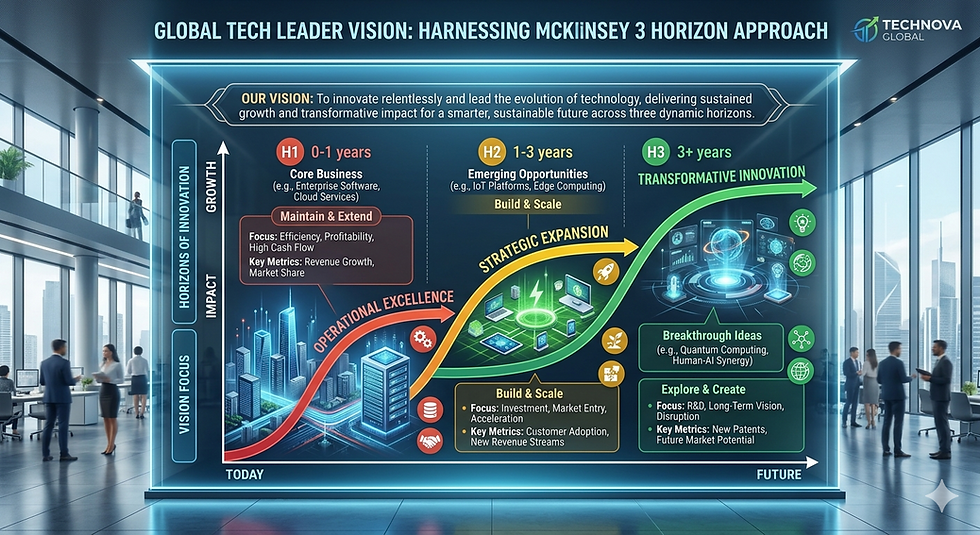
At Effilor, we believe in using structured frameworks to anchor this thinking. You cannot rely on gut feel alone. Tools like the 3 Horizon Approach help you balance your current core business (Horizon 1) with emerging opportunities (Horizon 2) and genuine long-term innovation (Horizon 3). By plotting these, you arrive at an "End State" that is both ambitious and logically grounded.
2. Radical Inclusion: Ownership Over Buy-in
A pitfall to avoid is for a CEO to write a vision in isolation and then try to "sell" it to the leadership team. This creates a "buy-in" culture, which is passive.
What you actually need is ownership.Involve your senior leadership team in the design of the end state from day one. Inviting them to visualise Horizon 2 and Horizon 3 challenges them to think beyond their operational responsibilities and develop a strategic thinking mindset.
3. Reverse Engineering the Roadmap (The Pre-Mortem)

Once the destination is agreed upon, the most critical question is: What must happen for this to become true?
Instead of planning forward from today, we propose a "Pre-Mortem" approach.
Imagine you are already five years in the future and the vision has been successfully achieved.
Now, walk backward to the present day.
What did we achieve in Year 4?
What had to be true by Year 2?
What is the very first milestone we hit six months from now?
By walking backward, you identify the critical success milestones that a forward-looking plan often misses.
When a leadership team collectively debates the pre-mortem—using tools like OGSM (Objectives, Goals, Strategies, and Measures)—they stop being spectators and start being architects. If they helped draw the map, they are much more likely to lead the march.
4. From Vision to Velocity: The BSQ Approach
A vision dies when it isn’t translated into immediate action. Once your milestones are set, assign dedicated teams to each one.
To ensure these teams don't get bogged down in "analysis paralysis," we advocate for the BSQ framework:

B – Think Big: Every team member must understand how their milestone connects to the 5-year Big picture.
S – Act Small: Break the success milestone down into small, manageable sprints. Don’t try to boil the ocean in a week.
Q – Move Quick: Speed is a competitive advantage. Focus on rapid iterations and quick wins to build momentum.
The Bottom Line
An inspiring vision is not a result of creative writing; it is a result of strategic clarity and collective ownership. When you combine structured tools like OGSM with a "walk-back" roadmap and a "Move Quick" execution bias, the vision ceases to be a statement. It becomes a shared journey.
Is your team clear on your 3-year end state, or are they just busy? Let’s help you define the roadmap.


Comments